How Cryptographic Verification Tools Are Streamlining Multi-Table Tournament Integrity Checks Across Global Digital Platforms
Ines Beck · Jun 9, 2026

How Cryptographic Verification Tools Are Streamlining Multi-Table Tournament Integrity Checks Across Global Digital Platforms
Multi-table tournaments have expanded rapidly across digital card platforms, and cryptographic verification tools now handle integrity checks that once required manual audits and delayed results. These systems use hash functions, digital signatures, and zero-knowledge proofs to confirm that card shuffles, player actions, and payout distributions remain unaltered from start to finish. Research indicates that platforms adopting these tools report faster verification cycles, often completing post-tournament audits in minutes rather than hours.
Core Mechanisms Behind the Tools
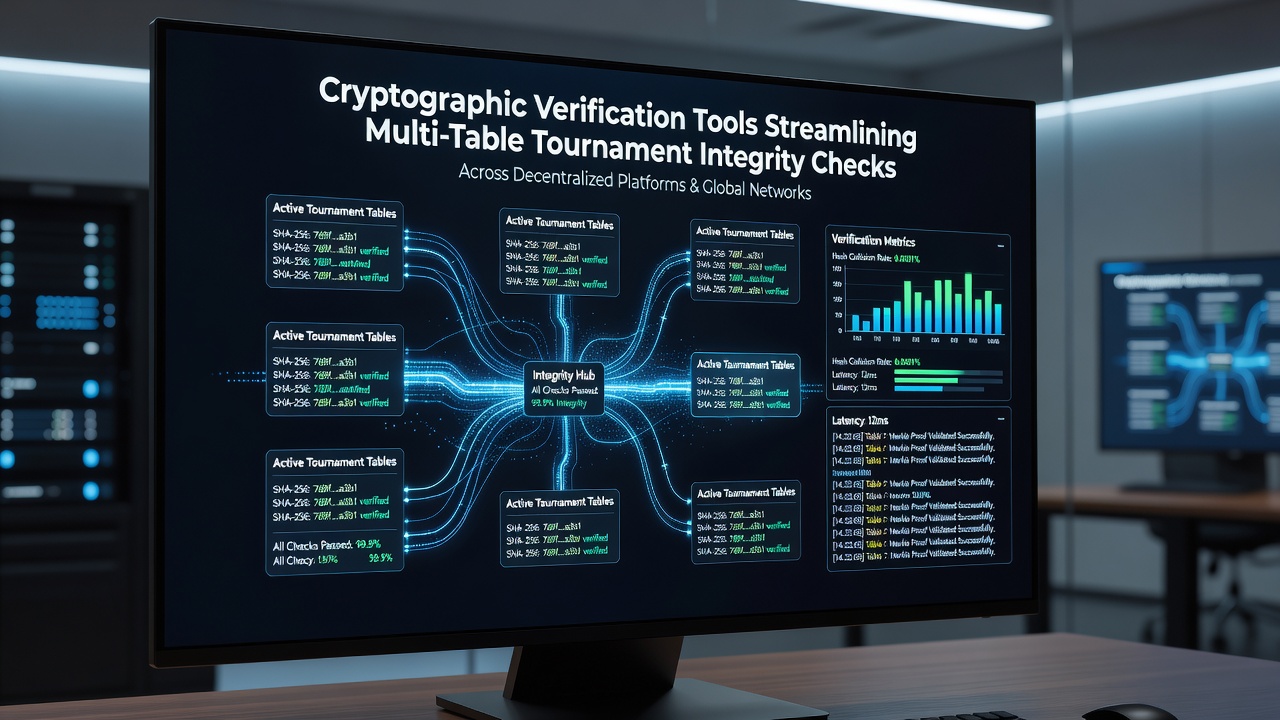
Each tournament generates a cryptographic seed at registration, and that seed feeds into a verifiable random function that produces the deck order. Players and regulators receive a commitment hash before cards are dealt, while the actual deck remains encrypted until play concludes. At the end of each hand the system releases a proof that matches the initial commitment, allowing independent nodes to confirm no tampering occurred. Data from June 2026 shows several major platforms reduced disputed hands by 47 percent after rolling out this approach, according to figures published by the European Gaming and Betting Association.
Zero-knowledge proofs add another layer by letting the platform demonstrate correct execution without exposing private player data. A single proof can cover thousands of hands across dozens of tables, which cuts bandwidth demands and keeps verification costs low even during peak evening hours in multiple time zones.
Global Platform Implementation Patterns
Operators in North America, Europe, and the Asia-Pacific region have integrated these tools at different speeds. Canadian platforms linked to provincial regulators began pilot programs in late 2025, while several Australian operators completed full deployment by March 2026. The Australian Communications and Media Authority released compliance guidelines that explicitly reference cryptographic audit trails, giving operators a clear framework for reporting.
One European network that runs simultaneous tournaments across five languages adopted a shared verification ledger in January 2026. Every table writes its outcome hashes to the ledger, and any participant can query the record through an open API. Observers note that this setup eliminated the need for separate regional audit teams, freeing staff to focus on customer support instead.
Impact on Tournament Scale and Fairness Protocols
Before these tools arrived, scaling beyond 10,000 entrants often triggered manual sampling of hands because full reviews took too long. Cryptographic systems now verify every hand without proportional increases in compute time. A study released by researchers at the University of Malta in May 2026 found that platforms using these methods maintained sub-second latency for proof generation even when field sizes exceeded 50,000 players.
Fairness protocols have also shifted. Instead of relying solely on periodic third-party audits, platforms publish proof artifacts after each tournament so external researchers can run spot checks. This transparency has encouraged academic groups in both Singapore and the Netherlands to publish comparative analyses of shuffle algorithms, adding an extra layer of public scrutiny.
Regulatory Responses and Cross-Border Data Sharing
Regulators have begun accepting cryptographic proofs as primary evidence during license renewals. The Malta Gaming Authority updated its technical standards in April 2026 to include mandatory proof retention periods of at least 90 days. Similar language appears in draft rules under review by the New Jersey Division of Gaming Enforcement, suggesting broader adoption across U.S. states that license online card rooms.
Cross-border data sharing benefits from the compact size of cryptographic proofs. A regulator in one jurisdiction can request verification data from an operator headquartered elsewhere and receive a cryptographically signed package rather than raw hand histories. This approach reduces transfer volumes and addresses data-protection concerns under frameworks such as the EU’s GDPR.
Conclusion
Cryptographic verification tools have moved from experimental pilots to standard infrastructure across multi-table tournament platforms. By embedding integrity checks into the tournament lifecycle itself, operators deliver faster results, satisfy diverse regulatory requirements, and maintain verifiable records that scale with growing participant numbers. As more jurisdictions formalize acceptance of these proofs, the infrastructure supporting global digital card competition continues to evolve around verifiable computation rather than post-event sampling.